
The IV bag is empty.The nurse is already there.
“Care that doesn’t require constant presence”
PRISMa is a smart monitoring system for gravity-fed infusion therapy. Load-cell weighing. Edge computing. Predictive alerts. No Wi-Fi required. Sets up in 10 seconds.
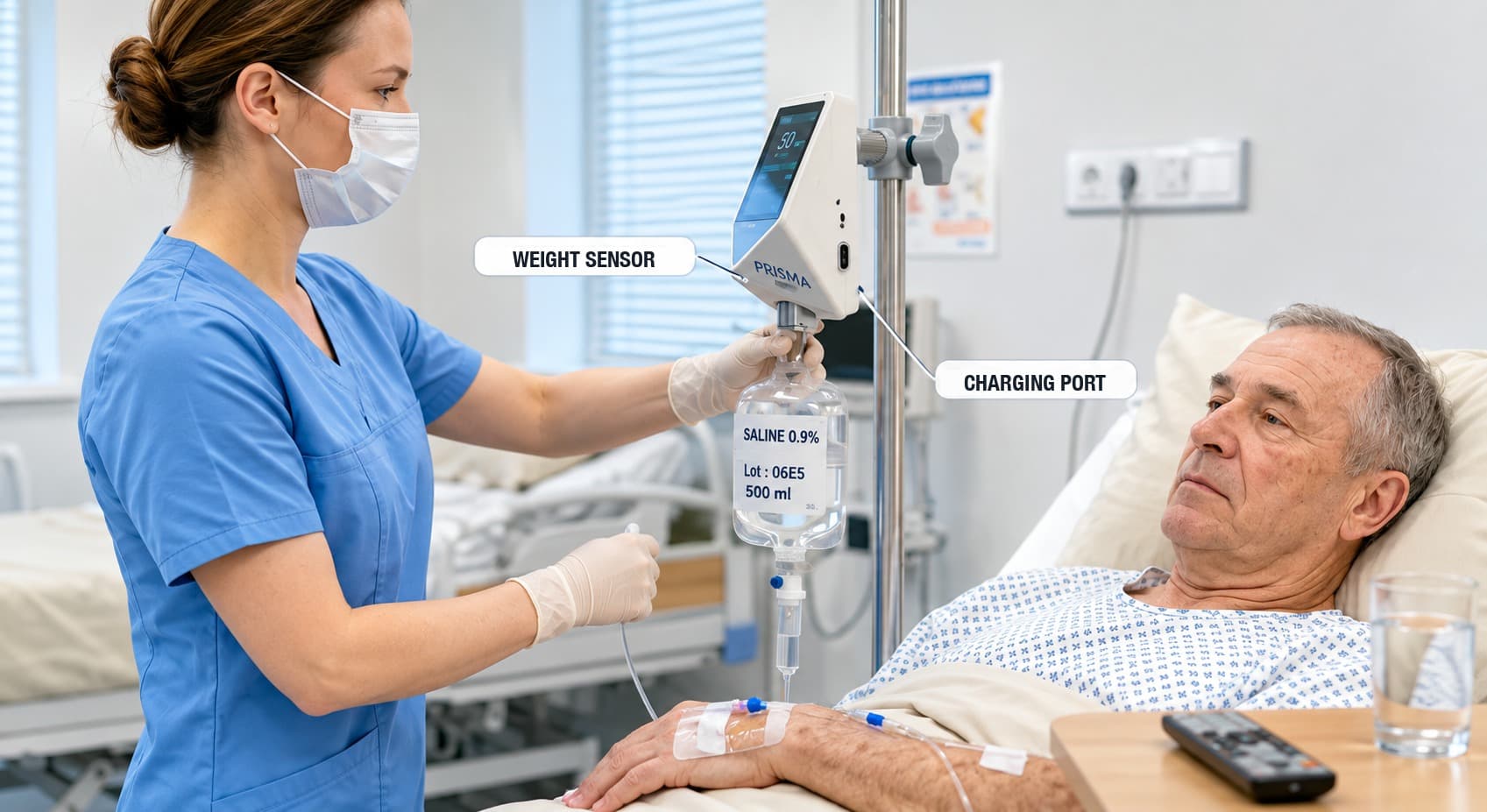
Manual infusion monitoring is not a standard — it is a major gap in the quality management system
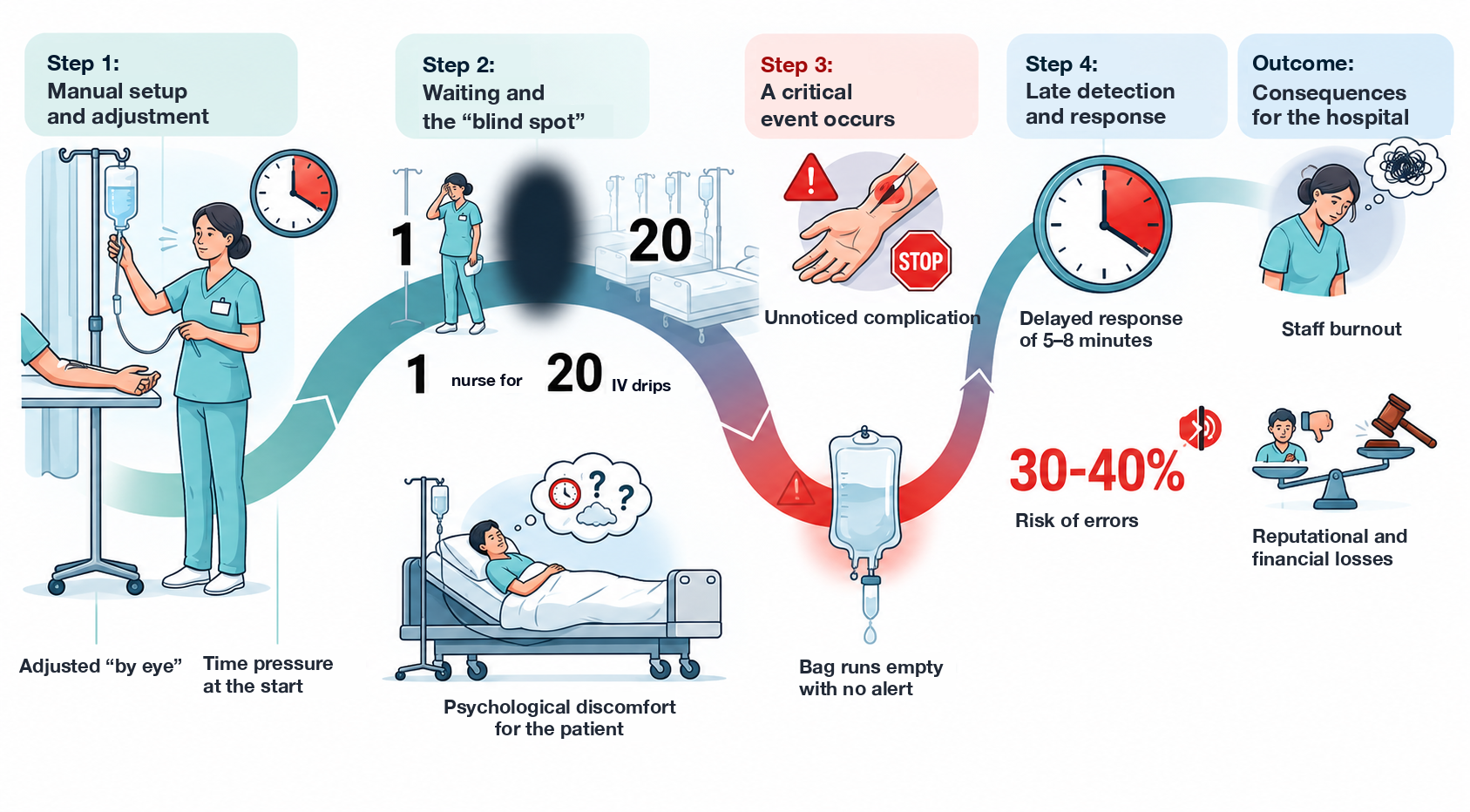
40–45 patients
per nurse per shift
Constant visual rounds to check IV lines take up to 30% of working time — time taken away from patient care and critical procedures.
5–8 minutes
average time to respond to the end of an infusion
A late response means a risk of air embolism, extravasation and patient complaints. Every incident brings internal reviews, regulatory inspections and legal exposure.
Still done by eye
in most wards using gravity infusion
Automated monitoring of gravity drips has not yet become standard practice: nurses still rely on rounds and patient calls. PRISMa fills this gap.
PRISMa: hang the bag, focus on the patient
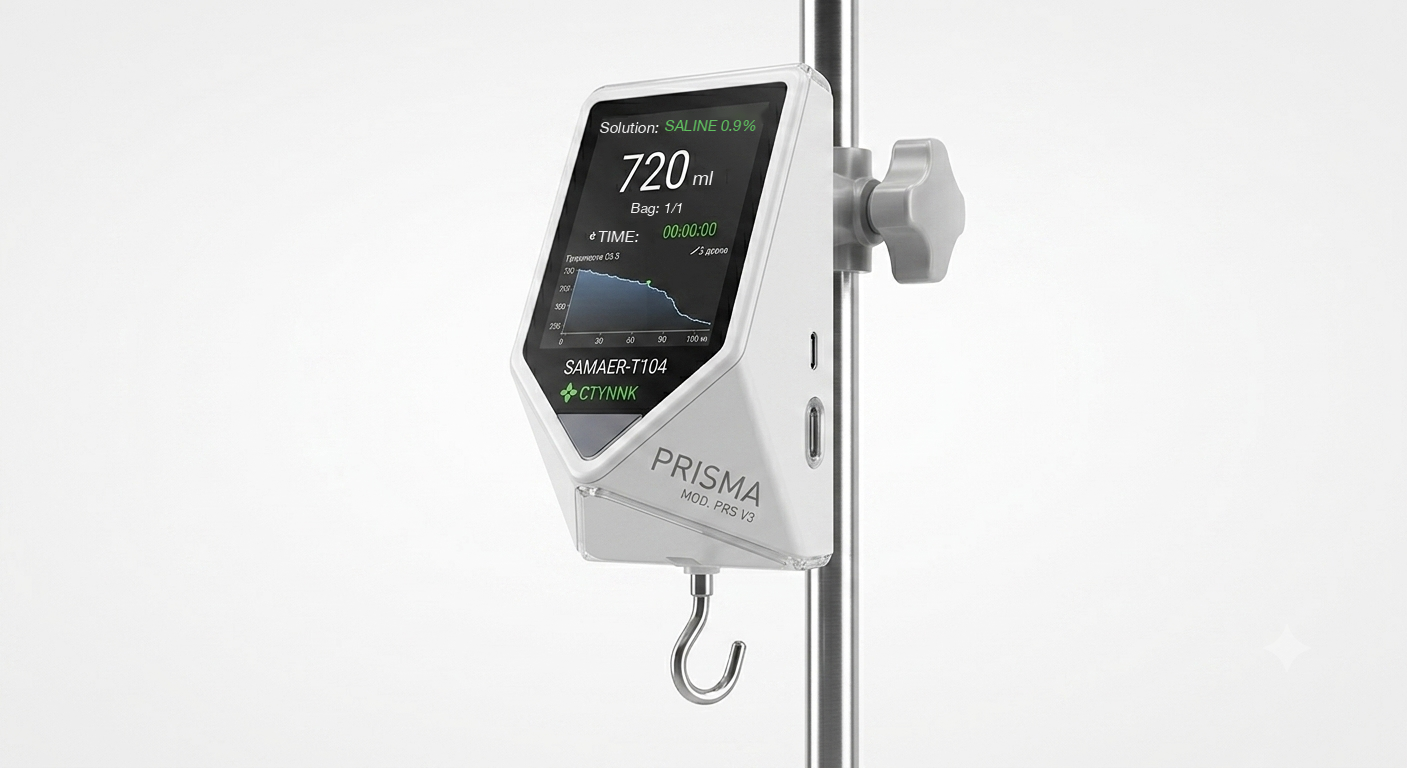
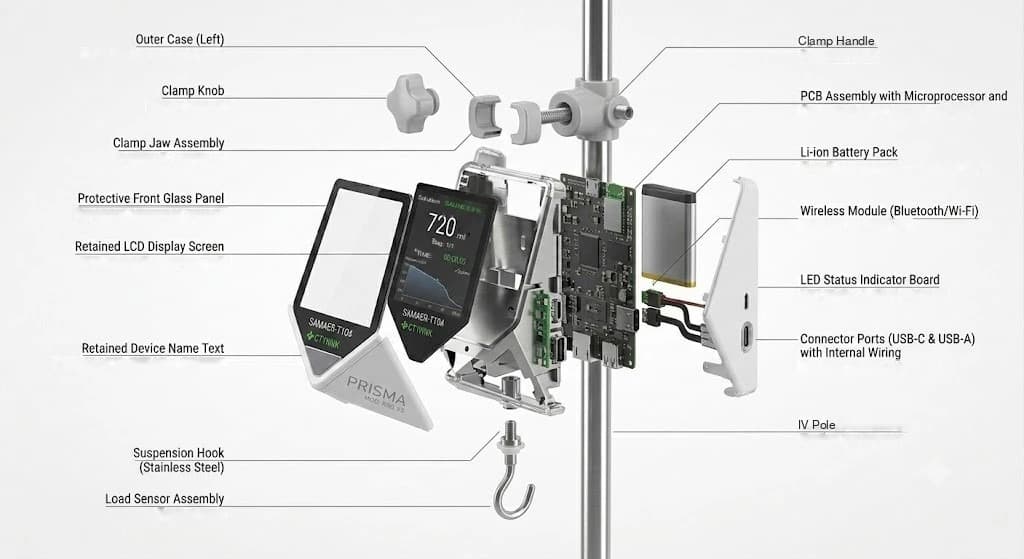
Weighing, not optics
The device measures the weight of the bag: ±5% accuracy regardless of the viscosity, colour or turbidity of the solution. Optical drop sensors fail with lipid emulsions and highly viscous drugs.
Edge architecture
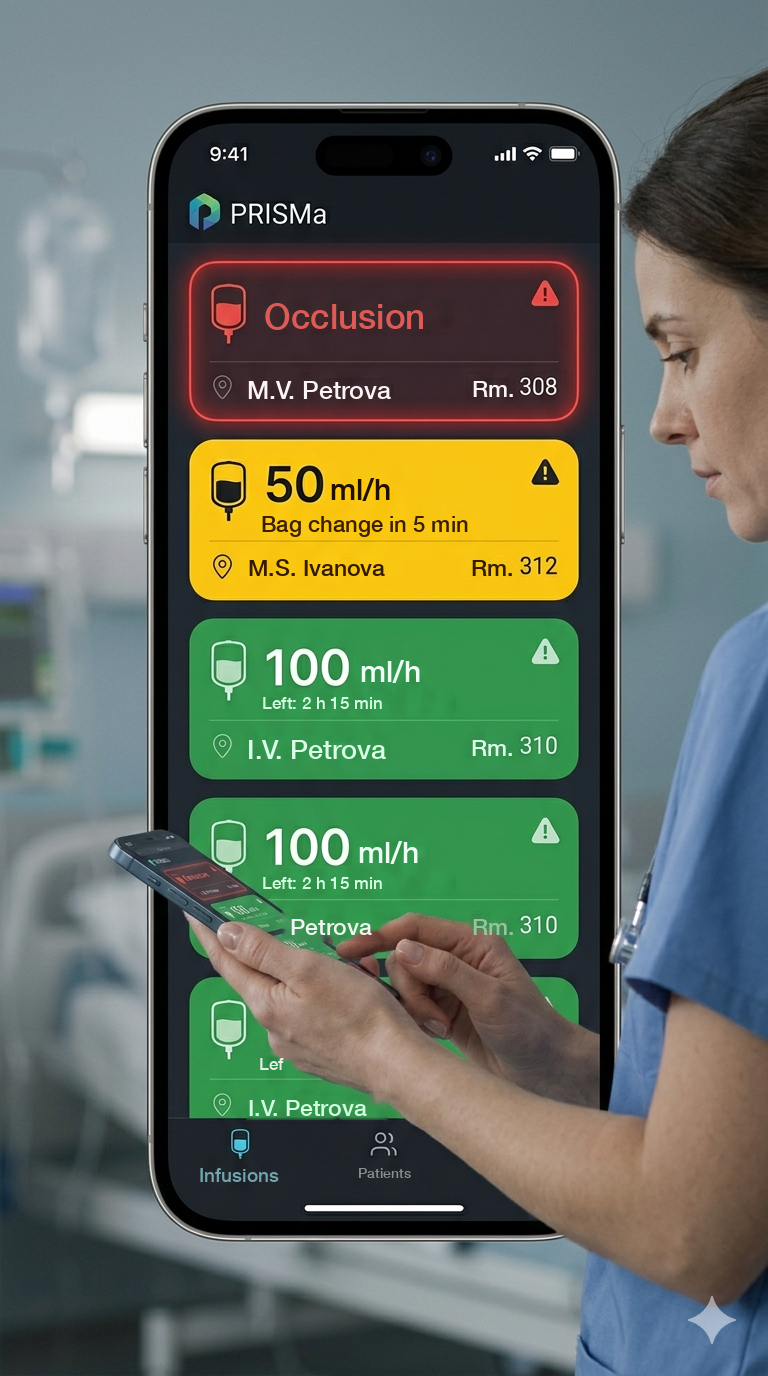
The device works autonomously, with no dependence on the hospital’s Wi-Fi, local network or IT infrastructure. Data is stored locally and synced with the nurse’s mobile app over Bluetooth (BLE).
Prediction, not reaction
A machine-learning algorithm calculates when the infusion will end. The push notification arrives 1–2 minutes before the event. False alarms caused by vibration are ruled out.
Ready in 10 seconds
No calibration for the type of solution. No QR code to scan at every bag change. Initial pairing is done once. After that, you just hang the bag.
How it works on the ward
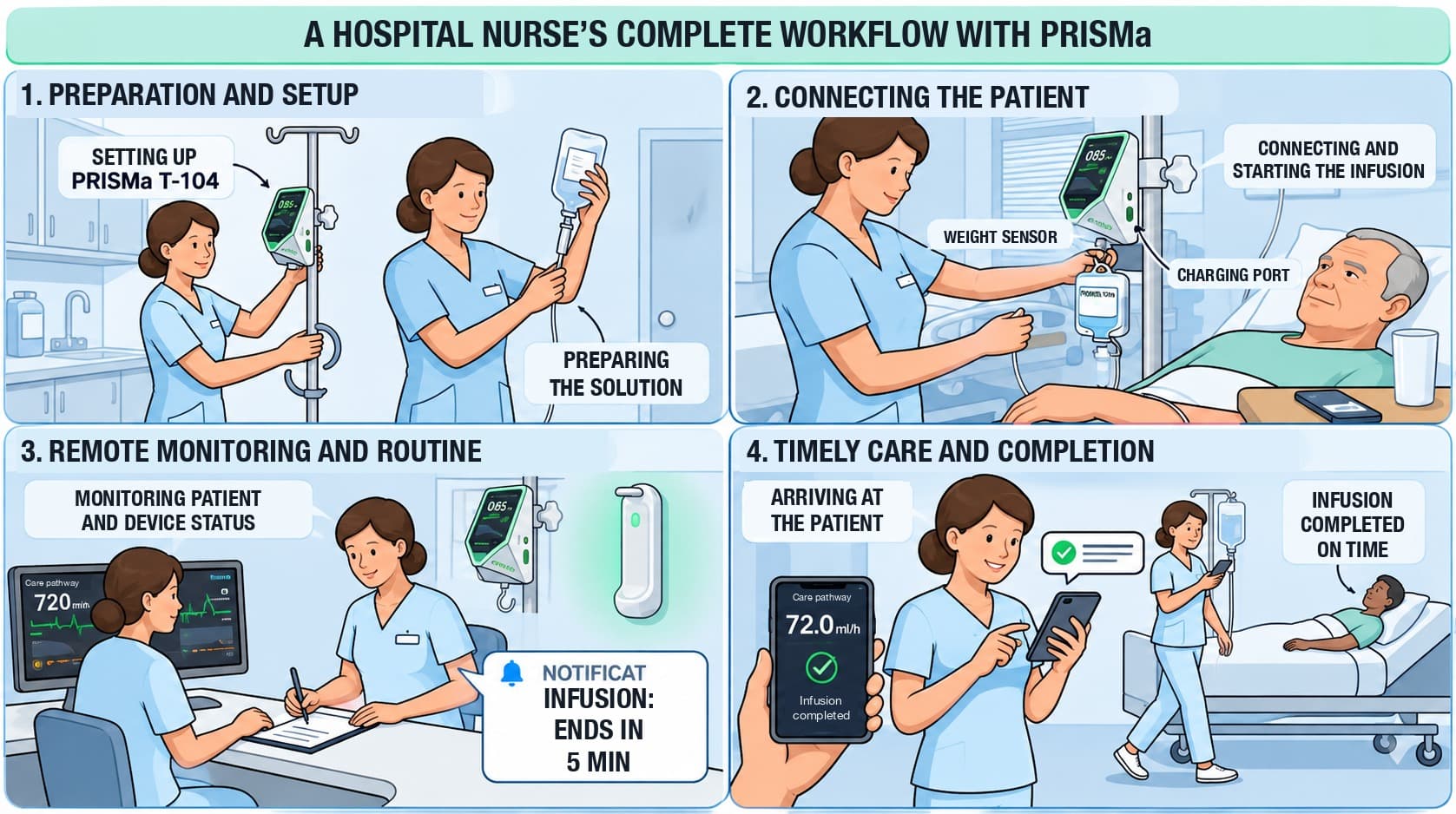
The nurse hangs the bag
The bag hangs on the PRISMa hook instead of the standard IV pole hook. No extra steps.
< 10 sThe device starts monitoring
The load cell records the weight. The accelerometer checks orientation. The edge controller builds a forecast in real time.
AutomaticPush notification 1–2 min ahead
The nurse gets an alert on her smartphone and arrives without rushing. The patient doesn’t have to call for help.
1–2 min before the eventAutomatic procedure log
The infusion, its start and end times and any deviations are logged automatically. Shift handover without manual paperwork.
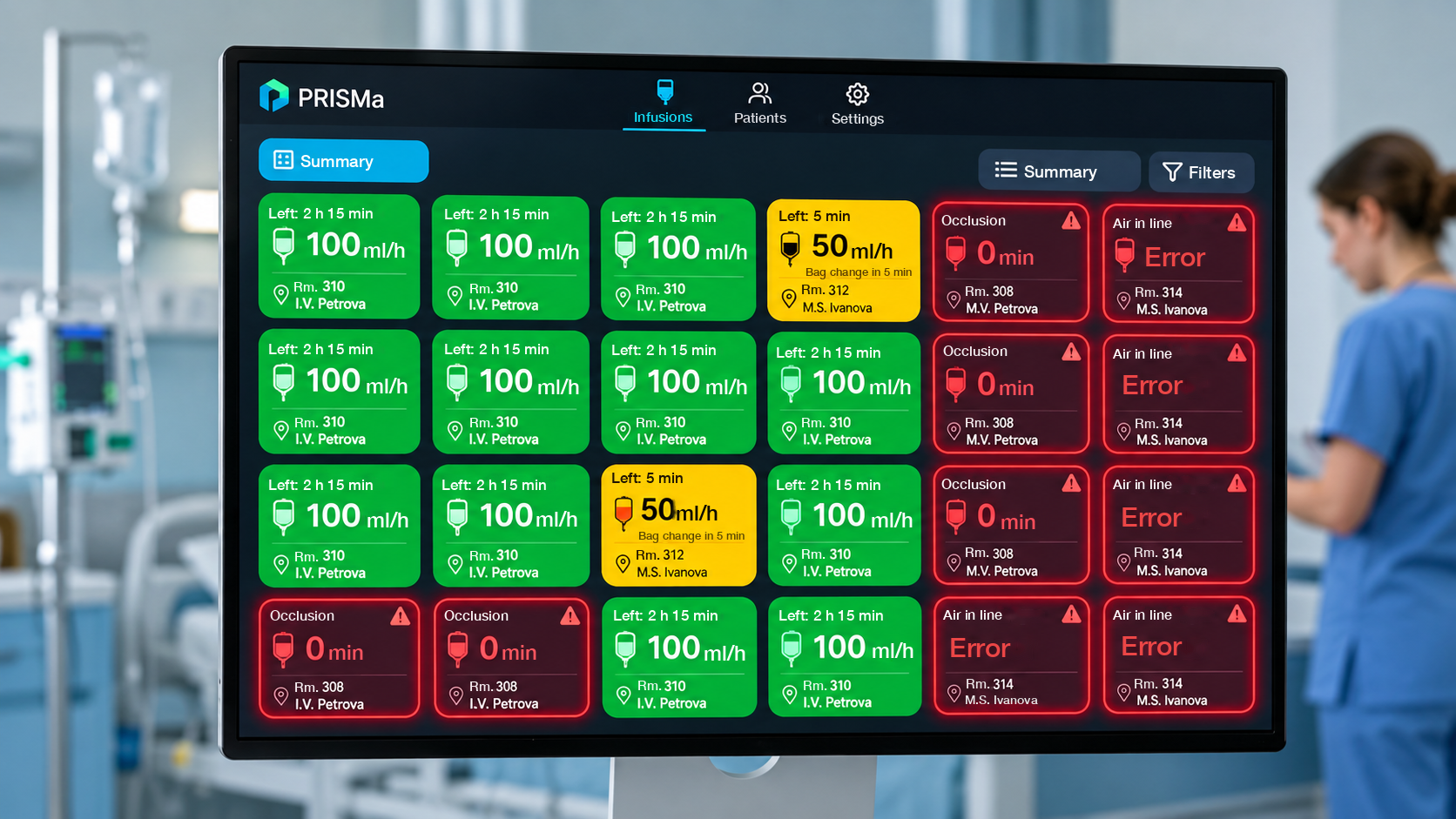
No nurse input neededDashboard for managers
The head nurse and the chief medical officer see the workload in real time. Reports export for the QMS, accreditation and inspections.
Web dashboard 24/7Value for everyone
End user
Elena, 38. Twelve-hour shifts, 40–45 patients. 15 years of experience. Wary of complicated technology.
Pain points
- Constant running between rooms to check IV lines visually
- Fear of missing the end of an infusion and being reprimanded
- Fatigue and cognitive overload by the end of the shift
- False calls from patients when the IV pole vibrates
What PRISMa delivers
- Setup in ≤ 10 seconds — no configuration or calibration
- Push notification 1–2 min ahead — time to arrive without rushing
- No false alarms — a calm working rhythm
- The automatic log cuts paperwork at shift handover
“Seriously? I just hang it and it works?”
First launch. Pilot, internal medicine ward, 2026
Regulatory status.
No speculation.
Medical device registration
In progressThe technical documentation package is ready and the device is going through medical device registration. Pilots are run as clinical research projects.
Patient data protection
Privacy by designPatient data never leaves the hospital perimeter. The edge architecture keeps processing local; only aggregated statistics are sent to the server.
In-house development
Full cycleHardware, firmware, algorithms and software are developed by the PRISMa team. The PRISMa trademark has been filed for registration; a utility model application is being prepared.
SaMD and interoperability
On the roadmapThe software is designed as SaMD (Software as a Medical Device). Integration with hospital information systems via HL7/FHIR is built into the product architecture.
The device is going through regulatory approval. Compliance information is current as of the publication date. Before making a purchasing decision, we recommend checking the current regulatory status.
How much your hospital saves
Estimates based on pilot data. Exact figures come in an individual TCO (total cost of ownership) report.
188
Devices needed
10,293 h
Staff time saved per year
8.8 months
Estimated payback period
Comparison with the most popular solutions on the market
← scroll the table →
| Criterion | PRISMa | DripAssist(Shift Labs, USA) | DripSet(Emsensing, India) | Monidrop(Monidor, Finland) | Manual checks |
|---|---|---|---|---|---|
| Measurement principle | Weighing (load cell) | Optical drop sensor | Optics + flow control | IR drop sensor + remote monitoring (IV Screen) | Visual |
| Accuracy | ±5% | Median error of 5% (clinical study) | Not specified | Not specified | Subjective |
| Dependence on hospital Wi-Fi | No | No — standalone audible alarm | Yes — connects to the app and portal | Yes — for remote monitoring (IV Screen) | No |
| Setup time | ≤ 10 s | Not specified (camera clip) | Not specified | Not specified | — |
| Predictive alert | 1–2 min ahead | Reactive (>13% deviation or stop) | Reactive (deviation alarm) | Reactive (occlusion / end-of-infusion alarm) | No |
| Quality (QMS) dashboard | Yes | No — standalone device | Not specified | Yes — IV Screen app, used in Finnish hospitals | No |
| HIS / EHR integration | In development | Not specified | Yes — app/portal, but no EHR | Not specified | No |
| Purchase model | EaaS / Purchase | Purchase (≈ $480, basic version — $335) | Not specified | Service subscription (recurring revenue) | — |
- Competitive advantage
- Intermediate
- Limitation
PRISMa — “Caring. Timely. Trusted.”
A 90-day pilot. With a results guarantee.
- No capital investment: the devices are provided as a service
- 30–50 devices per ward
- Duration: 90 days
- Guarantee: 50% refund if KPIs are not met
- Dedicated project manager
- Open to public and private hospitals with 50+ beds
Pilot target KPIs
- Infusion-related incidents down ≥ 30%
- Nursing staff NPS ≥ 8
- Response time to an event ≤ 2 min